UN Global Counter-Terrorism Strategy
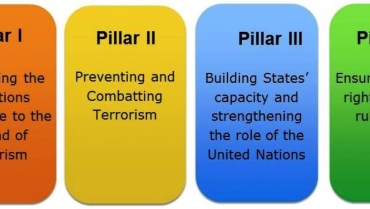
Adopted by consensus in 2006, The United Nations General Assembly adopted the Global Counter-Terrorism Strategy on 8 September 2006. The strategy is a unique global instrument to enhance national, regional and international efforts to counter terrorism. Through its adoption that all Member States have agreed the first time to a common strategic and operational approach to fight terrorism, not only sending a clear message that terrorism is unacceptable in all its forms and manifestation but also resolving to take practical steps individually and collectively to prevent and combat it.
Those practical steps include a wide array of measures ranging from strengthening state capacity to counter terrorist threats to better coordinating United Nations system’s counter-terrorism activities. The adoption of the strategy fulfiled the commitment made by world leaders at the 2005 September Summit and builds on many of the elements proposed by the Secretary-General in his 2 May 2006 report, entitled Uniting against Terrorism: Recommendations for a Global Counter-Terrorism Strategy. 2016 marks the 10th anniversary of the UN Global Counter-Terrorism Strategy.
Reviewed every 2 years
The General Assembly reviews the Strategy every two years, making it a living document attuned to Member States’ counter-terrorism priorities. The Fifth Review of the United Nations Global Counter-Terrorism Strategy took place on 1 July 2016. The General Assmbly examined the report of the Secretary-General (A/70/826) on the implementation of the UN Global Counter-Terrorism Strategy over the past decade. It also gave further consideration to the Secretary-General’s Plan of Action to Prevent Violent Extremism (A/70/674-A/70/675), which was presented by the Secretary-General to the General Assembly in January 2016. The General Assembly adopted the resolution (A/RES/70/291) by consenus.
4 Pillars
The fourth review of the Strategy took place in June 2014 (A/RES/68/276) and was preceded by a report from the United Nations Secretary-General (A/68/841) that included an overview of the evolving terrorism landscape, recommendations to address challenges and threats, and a compilation of measures taken by Member States and United Nations entities to fight against terrorism.
The Global Counter-Terrorism Strategy in the form of a resolution and an annexed Plan of Action (A/RES/60/288) is composed of 4 pillars:
- Addressing the conditions conducive to the spread of terrorism
- Measures to prevent and combat terrorism
- Measures to build states’ capacity to prevent and combat terrorism and to strengthen the role of the United Nations system in that regard
- Measures to ensure respect for human rights for all and the rule of law as the fundamental basis for the fight against terrorism.
Resolution: The United Nations Global Counter-Terrorism Strategy
The General Assembly, Guided by the purposes and principles of the Charter of the United Nations and reaffirming its role under the Charter, including on questions related to international peace and security, Reiterating its strong condemnation of terrorism in all its forms and manifestations, committed by whomever, wherever and for whatever purposes, as it constitutes one of the most serious threats to international peace and security.
ANNEX Plan of Action
We, the States Members of the United Nations, resolve: To consistently, unequivocally and strongly condemn terrorism in all its forms and manifestations, committed by whomever, wherever and for whatever purposes, as it constitutes one of the most serious threats to international peace and security. To take urgent action to prevent and combat terrorism in all its forms and manifestations.
I. Measures to address the conditions conducive to the spread of terrorism
We resolve to undertake the following measures aimed at addressing the conditions conducive to the spread of terrorism, including but not limited to prolonged unresolved conflicts, dehumanization of victims of terrorism in all its forms and manifestations, lack of rule of law and violations of human rights, ethnic, national and religious discrimination, political exclusion, socio-economic marginalization, and lack of good governance, while recognizing that none of these conditions can excuse or justify acts of terrorism.
II. Measures to prevent and combat terrorism
We resolve to undertake the following measures to prevent and combat terrorism, in particular by denying terrorists access to the means to carry out their attacks, to their targets and to the desired impact of their attacks: To refrain from organizing, instigating, facilitating, participating in, financing, encouraging or tolerating terrorist activities and to take appropriate practical measures to ensure that our respective territories are not used for terrorist installations or training camps.
III. Measures to build States’ capacity to prevent and combat terrorism and to strengthen the role of the United Nations system in this regard
We recognize that capacity-building in all States is a core element of the global counter-terrorism effort, and resolve to undertake the following measures to develop State capacity to prevent and combat terrorism and enhance coordination and coherence within the United Nations system in promoting international cooperation in countering terrorism.
IV. Measures to ensure respect for human rights for all and the rule of law as the fundamental basis of the fight against terrorism
We resolve to undertake the following measures, reaffirming that the promotion and protection of human rights for all and the rule of law is essential to all components of the Strategy, recognizing that effective counter-terrorism measures and the protection of human rights are not conflicting goals, but complementary and mutually reinforcing, and stressing the need to promote and protect the rights of victims of terrorism:
- To reaffirm that General Assembly resolution 60/158 of 16 December 2005 provides the fundamental framework for the “Protection of human rights and fundamental freedoms while countering terrorism”.
- To reaffirm that States must ensure that any measures taken to combat terrorism comply with their obligations under international law, in particular human rights law, refugee law and international humanitarian law.
- To consider becoming parties without delay to the core international instruments on human rights law, refugee law and international humanitarian law, and implementing them, as well as to consider accepting the competence of international and relevant regional human rights monitoring bodies.
- To make every effort to develop and maintain an effective and rule of law-based national criminal justice system that can ensure, in accordance with our obligations under international law, that any person who participates in the financing, planning, preparation or perpetration of terrorist acts or in support of terrorist acts is brought to justice, on the basis of the principle to extradite or prosecute, with due respect for human rights and fundamental freedoms, and that such terrorist acts are established as serious criminal offences in domestic laws and regulations. We recognize that States may require assistance in developing and maintaining such effective and rule of law-based criminal justice system, and we encourage them to resort to the technical assistance delivered, inter alia, by the United Nations Office on Drugs and Crime.
- To reaffirm the United Nations system’s important role in strengthening the international legal architecture by promoting the rule of law, respect for human rights, and effective criminal justice systems, which constitute the fundamental basis of our common fight against terrorism.
- To support the Human Rights Council, and to contribute, as it takes shape, to its work on the question of the promotion and protection of human rights for all in the fight against terrorism.
- To support the strengthening of the operational capacity of the Office of the United Nations High Commissioner for Human Rights, with a particular emphasis on increasing field operations and presences. The Office should continue to play a lead role in examining the question of protecting human rights while countering terrorism, by making general recommendations on States’ human rights obligations and providing them with assistance and advice, in particular in the area of raising awareness of international human rights law among national law-enforcement agencies, at States’ request. To support the role of the Special Rapporteur on the promotion and protection of human rights and fundamental freedoms while countering terrorism. The Special Rapporteur should continue to support States’ efforts and offer concrete advice by corresponding with Governments, making country visits, liaising with the United Nations and regional organizations, and reporting on these issues.